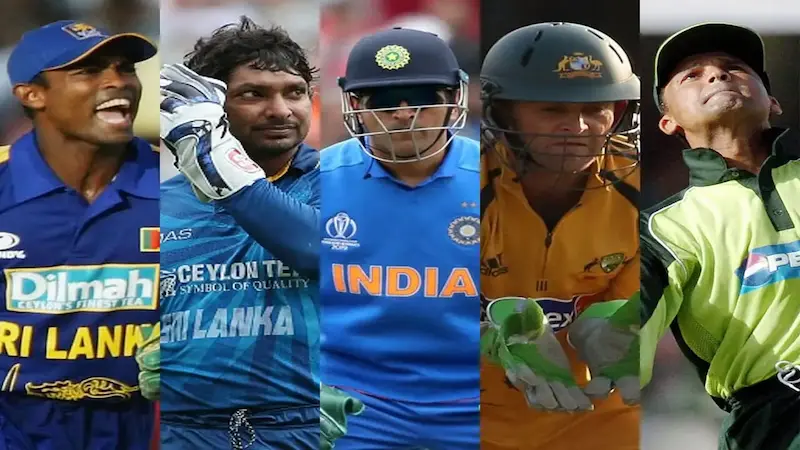
Cricket has produced some extraordinary wicketkeepers who have transformed the very way the game is played. From lightning-fast stumpings to spectacular diving catches, these players have demonstrated that wicketkeeping demands remarkable concentration, athletic ability, and technical skill.
Table of Contents
ToggleHowever, modern wicketkeepers are expected to do much more than stand behind the stumps. They must contribute valuable runs, understand bowling strategies, guide field placements, and remain calm during high-pressure situations.
Over the years, several legendary players have established themselves as some of the greatest wicketkeepers in cricket history. Australia’s Adam Gilchrist transformed the role with his aggressive batting, India’s MS Dhoni became famous for his lightning-fast glove work, and South Africa’s Mark Boucher established remarkable records through consistency and dedication.
When discussing the top 3 wicketkeepers in cricket, it is important to consider more than just the number of catches and stumpings. Batting contribution, performance across formats, consistency, match-winning performances, and influence on the game also matter.
READ MORE: https://sportstitanofficial.com/top-3-fastest-football-player-of-all-time/
https://x.com/fpjindia/status/2077782899693330503?s=20
How Do We Identify the Greatest Wicketkeepers in Cricket?
Before comparing individual players, it is important to understand what makes someone an exceptional wicketkeeper.
Wicketkeeping is one of the most technically demanding positions in cricket. A player must maintain concentration throughout long periods, react quickly to unexpected deliveries, and make difficult decisions within fractions of a second.
Several factors help determine a wicketkeeper’s overall greatness.
1. Catching ability: A reliable wicketkeeper must take difficult catches against fast bowlers and spinners.
2. Stumping skills: Quick hands and excellent anticipation are essential for removing batters who leave their crease.
3. Batting contribution: Modern wicketkeepers are often expected to contribute significantly with the bat.
4. Consistency: Performing regularly across different conditions and formats separates outstanding players from ordinary ones.
5. Match impact: The ability to influence important matches through keeping, batting, and leadership adds considerable value.
Using these factors, three players stand out for their extraordinary contributions to international cricket.
1. Adam Gilchrist – The Wicketkeeper Who Changed Modern Cricket
Adam Gilchrist is widely regarded as one of the most influential wicketkeeper-batters in cricket history. He changed traditional expectations by combining outstanding wicketkeeping skills with incredibly aggressive batting.
Before Gilchrist became a regular member of the Australian team, wicketkeepers were often selected primarily for their ability behind the stumps. He showed that a wicketkeeper could also become one of the most dangerous batters in the playing eleven.
His attacking approach gave Australia an enormous advantage, particularly in Test cricket, where his ability to score quickly could completely change the direction of a match.
Gilchrist’s international career and records
Gilchrist represented Australia between 1996 and 2008. During this period, he became a key member of one of the most successful international teams ever assembled.
Some of his major career achievements include:
- 96 Test matches.
- 287 One-Day Internationals.
- 5,570 Test runs.
- 9,619 ODI runs.
- 17 test centuries.
- 16 ODI centuries.
- 905 international wicketkeeping dismissals.
His wicketkeeping record includes 813 catches and 92 stumpings across international cricket.
These numbers demonstrate his remarkable contribution with both bat and gloves.
What made Adam Gilchrist special?
Gilchrist’s greatest strength was his ability to attack bowlers without losing control of his technique.
He was particularly dangerous against fast bowling and could change the momentum of an innings within a few overs.
His batting also gave Australia greater flexibility. The team could play an additional specialist bowler because Gilchrist provided so much value as a batter.
Gilchrist scored an outstanding 149 runs from just 104 deliveries, helping Australia secure another World Cup title.
His performance remains one of the most memorable innings in World Cup final history.
His wicketkeeping legacy
Gilchrist was not simply an aggressive batter who happened to wear wicketkeeping gloves.
He was an excellent keeper with impressive catching ability and strong awareness behind the stumps.
The ICC inducted him into its Hall of Fame in 2013, recognizing his extraordinary contribution to international cricket.
His influence remains visible in modern cricket, where teams increasingly expect wicketkeepers to provide substantial batting value.
For many cricket experts, Gilchrist represents the perfect combination of aggressive batting and dependable wicketkeeping.
2. MS Dhoni – India’s Most Iconic Wicketkeeper and Finisher
MS Dhoni is one of the most well-known wicketkeepers in the history of cricket. His exceptional wicketkeeping, calm demeanor, ability to finish matches, and leadership transformed the face of Indian cricket.
Unlike many traditional wicketkeeper-batters, Dhoni developed a playing style that combined powerful hitting with remarkable tactical awareness.
His quick hands behind the stumps made him particularly dangerous against spinners. Batters often struggled to judge how quickly he could collect the ball and remove the bails.
Dhoni’s international career and achievements
Dhoni made his international debut in 2004 and quickly established himself as an important member of India’s limited-overs team.
His major international achievements include:
- 90 Test matches.
- 350 One-Day Internationals.
- 98 T20 Internationals.
- 4,876 Test runs.
- 10,773 ODI runs.
- 1,617 T20I runs.
- 829 international wicketkeeping dismissals.
His international dismissal record includes 634 catches and 195 stumpings.
Dhoni’s 195 stumpings are particularly impressive. They demonstrate his anticipation, coordination, and ability to react quickly when batters move outside their crease.
Why is MS Dhoni considered one of the greatest?
Dhoni’s greatest strength was his ability to remain calm even under pressure.
Whether India needed a difficult run chase or an important wicket, he rarely appeared rushed.
His wicketkeeping technique was especially effective against spin bowling. He often collected the ball with minimal movement and completed stumpings before the batter could return to the crease.
Another important part of his legacy is leadership.
Under Dhoni’s captaincy, India won three major ICC men’s white-ball tournaments:
- 2007 ICC Men’s T20 World Cup.
- 2011 ICC Men’s Cricket World Cup.
- 2013 ICC Champions Trophy.
His contribution to the 2011 World Cup final remains unforgettable for Indian cricket fans. Dhoni scored an unbeaten 91 against Sri Lanka and finished the match with a memorable six.
Dhoni’s influence on modern wicketkeeping
Dhoni helped establish a new standard for wicketkeeper-batters in India.
He showed that a wicketkeeper could be a powerful finisher, an intelligent captain, and a reliable specialist behind the stumps.
His influence extends beyond international cricket through his performances and leadership in the Indian Premier League.
For many fans, Dhoni is the strongest candidate for the title of the greatest wicketkeeper in cricket history, particularly when leadership and match-winning ability are included in the comparison.
3. Mark Boucher—The Record-Breaking South African Wicketkeeper
Mark Boucher deserves a special place among cricket’s greatest wicketkeepers.
While Gilchrist became famous for aggressive batting and Dhoni for extraordinary stumpings, Boucher established his reputation through remarkable consistency, concentration, and exceptional catching ability.
He spent more than a decade representing South Africa and became one of the most dependable wicketkeepers of his generation.
His career was built on discipline and the ability to perform consistently against some of the strongest batting line-ups in international cricket.
Mark Boucher’s international career statistics
Boucher represented South Africa between 1997 and 2012.
His international career included:
- 147 Test matches.
- 295 One-Day Internationals.
- 25 T20 Internationals.
- 5,515 Test runs.
- 4,686 ODI runs.
- 998 international wicketkeeping dismissals.
His dismissal record includes 952 catches and 46 stumpings.
The most remarkable achievement is his overall dismissal record. Boucher finished his international career with 998 dismissals, making him the leading wicketkeeper in this statistical category among these three players.
What made Mark Boucher an exceptional keeper?
Boucher’s biggest strength was consistency.
He was particularly effective against fast bowling and regularly took difficult catches behind the stumps.
Keeping wickets to fast bowlers requires excellent positioning, quick reactions, and the ability to follow the movement of the ball.
Boucher demonstrated these qualities throughout his international career.
His batting was another valuable part of his contribution. Although he was not as explosive as Gilchrist, he frequently delivered important lower-order runs.
One memorable example came during South Africa’s famous 438-run chase against Australia in Johannesburg in 2006.
Boucher scored an unbeaten 50 and hit the winning boundary, helping South Africa complete one of the greatest successful run chases in ODI history.
An unfortunate end to his career
Boucher’s international career ended in 2012 following a serious eye injury during a warm-up match against Somerset.
The injury forced him to retire from international cricket.
He finished just two dismissals short of the remarkable 1,000-dismissal milestone.
Despite this unfortunate ending, his records and consistency have secured his position among cricket’s greatest wicketkeepers.
Comparing the Top Three Wicketkeepers
The three players brought different strengths to international cricket. Their career statistics help explain why each deserves recognition.
| Career achievement | Adam Gilchrist | MS Dhoni | Mark Boucher |
|---|---|---|---|
| Test matches | 96 | 90 | 147 |
| ODI matches | 287 | 350 | 295 |
| Test runs | 5,570 | 4,876 | 5,515 |
| ODI runs | 9,619 | 10,773 | 4,686 |
| International dismissals | 905 | 829 | 998 |
| Catches | 813 | 634 | 952 |
| Stumpings | 92 | 195 | 46 |
Statistics are career figures at retirement; international dismissal totals refer to catches and stumpings as wicketkeepers.
Who leads in each category?
- Most international dismissals: Mark Boucher.
- Most international stumpings: MS Dhoni.
- Highest ODI runs among the three: MS Dhoni.
- Most ODI catches: Adam Gilchrist.
- Most aggressive batting influence: Adam Gilchrist.
- Most notable international captaincy achievements: MS Dhoni.
These comparisons reveal that greatness cannot be measured through a single statistic.
Honourable Mention: Kumar Sangakkara
Any discussion about legendary wicketkeepers would be incomplete without Kumar Sangakkara.
The former Sri Lankan captain was an exceptional batter and a highly accomplished wicketkeeper.
He scored 12,400 runs in Test cricket and 14,234 runs in ODIs, making him one of the most successful batters in international cricket history.
As an ODI wicketkeeper, Sangakkara recorded 482 dismissals, including 383 catches and 99 stumpings.
This is the highest ODI dismissal total among wicketkeepers.
His batting consistency, technical ability and contribution to Sri Lankan cricket make him a serious contender in any discussion about the greatest wicketkeeper-batters.
He deserves special recognition even though this article focuses on three players.
Who Is the Best Wicketkeeper in Cricket History?
Choosing one player as the greatest wicketkeeper is difficult because every generation has different playing conditions and expectations.
Mark Boucher has the strongest overall international dismissal record among the three players discussed. His consistency behind the stumps was exceptional.
Adam Gilchrist transformed the role of wicketkeeper-batter by combining reliable keeping with extraordinary attacking ability.
MS Dhoni brought together exceptional stumpings, finishing ability and leadership. His influence on Indian cricket makes his legacy particularly special.
If the main consideration is pure wicketkeeping consistency and total dismissals, Mark Boucher has an outstanding case.
If batting impact and the ability to change matches are included, Adam Gilchrist becomes an extremely strong candidate.
If leadership, stumpings, finishing and overall influence are considered together, MS Dhoni is a compelling choice.
In my assessment, Adam Gilchrist deserves the overall number-one position for the way he transformed the wicketkeeper-batter role. However, there is no universally accepted winner, and reasonable cricket fans can reach different conclusions.
Conclusion
Wicketkeepers have always played an important role in cricket, but the expectations surrounding the position have changed considerably.
Adam Gilchrist proved that a wicketkeeper could dominate international bowling attacks with aggressive batting. MS Dhoni demonstrated how exceptional glove work, leadership and finishing ability could transform a team. Mark Boucher established extraordinary standards of consistency and became the most successful wicketkeeper in international cricket by total dismissals among these legends.
The Top 3 Wicketkeepers in Cricket represent three different approaches to excellence. Their careers show that great wicketkeeping requires technical skill, concentration, athletic ability and an understanding of the game.
Although selecting the greatest player will always remain a matter of debate, these three legends have earned their places among cricket’s finest.
Their records continue to inspire young wicketkeepers who dream of representing their countries and creating their own place in cricket history.









3 thoughts on “Top 3 Wicketkeepers in Cricket: Who Is the Best Wicketkeeper in Cricket History?”