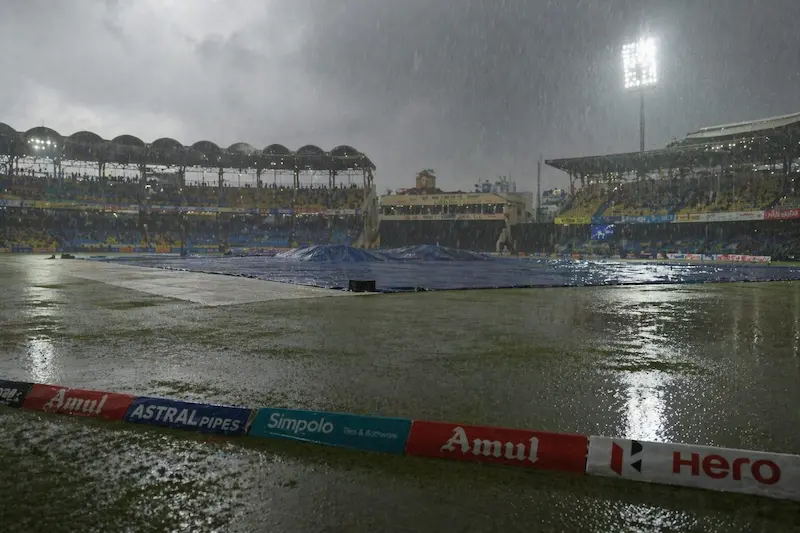
Imagine that in a cricket match, one team scores 180 runs in 20 overs, but the match is interrupted by rain during the second innings. When play resumes, the team chasing the target has fewer overs remaining to reach its goal. Should it still be required to score the same 181 runs? Or, should the target be adjusted to account for the time lost due to rain?
This is where the Duckworth-Lewis-Stern (DLS) method comes into play.
Rain interruptions can change the entire direction of a cricket match. Without a fair adjustment, the team batting second could face a disadvantage simply because it has less time to score its runs. The DLS method addresses this problem by adjusting the target according to the overs remaining and the batting resources available to each team.
Understanding how rain affected cricket match rules helps fans make sense of revised targets, unexpected results, and those confusing scoreboards that appear after a rain delay.
From the basic calculation to real match situations, this guide explains how the DLS method works, when officials use it, and why it matters in modern limited-overs cricket.
READ MORE: https://sportstitanofficial.com/top-3-wicketkeepers-in-cricket/
https://x.com/cricbuzz/status/2111070466077261965?s=20
1. What Does DLS Stand for in Cricket?
DLS stands for Duckworth-Lewis-Stern, a mathematical method used to calculate revised targets in limited-overs cricket when interruptions reduce the time available for play.
The method was originally developed by English statisticians Frank Duckworth and Tony Lewis. Australian statistician Steven Stern later refined it, and his name was added in 2014. The International Cricket Council (ICC) adopted the original method in the late 1990s.
For example, a team chasing 280 runs in a 50-over ODI has a very different task if rain reduces its innings to 35 overs. It cannot approach the chase in exactly the same way, because it has less time to build an innings.
The DLS method considers two important resources:
Overs remaining: How many deliveries the batting team still has available.
Wickets remaining: How many batters are still available before the innings ends.
These factors work together. A team with eight wickets in hand can usually attack more freely than a team that has already lost seven wickets, even if both have the same number of overs left.
The ICC provides official DLS methodology documents, resource tables, and calculation tools for match officials.
Before the DLS method, rain-affected matches were handled using other approaches that could create unfair outcomes.
One famous example came during the 1992 Cricket World Cup semi-final between South Africa and England. After a rain interruption, South Africa’s target changed dramatically under the method then in use. The team went from needing 22 runs off 13 balls to needing 22 off just one ball.
The incident became a powerful illustration of why a better system was needed.
The DLS method attempts to account for these differences by estimating the scoring resources available to both sides.
Here is why that matters:
A team losing overs early in its innings may have more wickets available and can still plan an aggressive chase.
A team losing overs late may already have spent much of its batting opportunity.
A team with several wickets in hand has more flexibility than one close to being bowled out.
The objective is not to predict the winner. It is to adjust the target so the two teams’ scoring opportunities are treated as fairly as possible.
3. How Does the DLS Method Work?
The key idea behind the method is called resources. Rather than looking only at runs scored or overs bowled, DLS estimates how much scoring opportunity remains at a particular stage of an innings.
A full 50-over innings with ten wickets available represents 100% of the available resources in the standard ODI framework. As overs are used and wickets fall, the percentage of resources remaining decreases.
The calculation then compares the resources available to the first team with those available to the chasing team.
The basic principle
The calculation takes account of:
The first team’s final score.
The resources available to the first team.
The resources available to the second team after interruptions.
The official DLS calculation applicable to that match.
The chasing team’s target may increase or decrease depending on the relative resources available to the two teams. It is not automatically reduced every time rain interrupts a match.
When the chasing team has fewer scoring resources available than the first team, the basic relationship can be expressed as:
This is a simplified explanation of the resource comparison, not a complete substitute for the official DLS calculation. The exact target depends on the circumstances of the interruption, the applicable DLS edition, and the competition’s playing conditions.
When the chasing team has greater resources available than the first team used, the calculation is different; officials cannot simply apply the same proportion in every situation.
Let’s use a simplified example to understand the idea.
Example: A rain-interrupted ODI
First team score
280 runs
Original innings
50 overs
Chasing the team’s resources
80% (illustrative)
For illustration only, assume the first team had 100% resources available and the chase has 80% under the relevant calculation.
Under this simplified proportional illustration, the par score would be around 224 runs, and a target above par would be required to win. The exact official target cannot be determined from this example alone because actual resource percentages must come from the applicable DLS calculation.
The important lesson is that losing 20% of the resources does not necessarily mean losing 20% of the overs. Wickets and the timing of the interruption also matter.
A real-world example
A paper published in the Royal Statistical Society’s Significance journal describes a Sri Lanka versus Zimbabwe ODI in July 2017. Sri Lanka scored 300, while Zimbabwe scored 139 for 3 after 21 overs when rain interrupted play. The revised conditions left Zimbabwe with a target of 219.
5. Rain-Affected Cricket Match Rules in ODI and T20 Cricket
The rain affected cricket match rules depending on the match format, the competition’s playing conditions, and how much play was lost.
Although the DLS method is used in both One Day Internationals (ODIs) and Twenty20 (T20) cricket, the number of overs available and the minimum playing requirements may differ.
What happens when rain interrupts a match?
Play is stopped: The umpires suspend the match if conditions become unsuitable or unsafe.
Officials assess the delay: They determine whether play can resume and how much time remains.
Overs may be reduced: If the original innings length cannot be maintained, the playing conditions may require a shorter match.
The target is recalculated: If necessary, the match officials use the applicable DLS calculation to set a revised target.
The match resumes, or a result is determined: If play cannot continue, the result depends on the applicable competition rules and the score relative to the DLS par score.
These are the general steps. The precise procedures, minimum overs, and result conditions should always be checked against the relevant tournament’s regulations.
Not necessarily.
| Rule | ODI cricket | T20 cricket |
|---|---|---|
| Original innings length | Usually 50 overs per team | Usually 20 overs per team |
| DLS target adjustment | Used when qualifying interruptions affect available resources | Used when qualifying interruptions affect available resources |
| Over after a delay | May be reduced | May be reduced |
| Minimum overs for a result | Depends on applicable playing conditions | Depends on applicable playing conditions |
| Abandoned match outcome | Determined by competition rules | Determined by competition rules |
The table describes typical international formats, not a universal set of regulations for every domestic league or tournament.
6. What Is a DLS Par Score?
A DLS par score tells spectators how many runs the chasing team would need to have scored at a particular point to be level with the adjusted target under the applicable conditions.
This is different from the final target.
Suppose a scoreboard shows:
Team A: 180 runs.
Team B: 90 runs after 10 overs.
DLS par score: 96 runs.
If the innings were abandoned at that exact point and the applicable rules used that par score, Team B would be six runs below par.
If the chasing team were above par, it could be ahead under the relevant result rules. If level with par, it could be tied. If below par, it could be behind.
Important: A par score is not always the number required to win. The final target is normally one run higher than the tie score. The exact result depends on the official calculation, the moment play stops, and the competition’s regulations.
7. What Happens If Rain Stops the Match During the Second Innings?
This is one of the most common situations in cricket.
If the chasing team has not completed its innings and rain prevents play from resuming, officials may compare its score at the interruption with the relevant DLS par score, provided the conditions for a result have been met.
For example:
Team A scores 175 runs.
Team B reaches 110 runs.
The applicable DLS par score at the interruption is 105.
If the match is abandoned at that point and the relevant playing conditions allow a result, Team B may be declared the winner because it is five runs ahead of par.
If Team B were on 100 instead, it would be five runs behind par and could lose.
These are illustrative figures, not a calculation for a specific match. A valid result also depends on the required minimum overs and other applicable rules.
There is no single minimum-overs rule that applies to every cricket match.
For example, international ODIs and T20 internationals have format-specific playing conditions. Domestic tournaments may also have their own regulations covering shortened innings and abandoned matches.
The relevant rules determine whether enough play has taken place for a result to be declared. Officials must also consider whether the second team has received the required opportunity to bat.
This is why a match can be abandoned without a winner even after several overs have been played.
To avoid confusion, check the official playing conditions for the particular tournament rather than assuming that the same minimum applies to every ODI, T20, or league match.
9. Does DLS Always Help the Team Batting Second?
No. The method is designed to account for the resources available to both teams, not to favour one side.
Depending on the circumstances, a revised target may be lower or higher than the original target would suggest.
For instance, a team chasing a large total may receive fewer overs after a delay, resulting in a revised target. However, the calculation considers wickets and resources as well as time. It does not simply award a win to the chasing team because rain has interrupted play.
Similarly, a first-innings interruption can change the number of overs available to the first team and affect the resources used in the comparison.
The Rain affected cricket match rules are intended to maintain a reasonable balance between the two sides, although no mathematical method can eliminate every debate about fairness.
10. Common Myths About the DLS Method
Several misconceptions make the system seem more complicated than it really is.
Myth 1: DLS only reduces the target.
Not always. The revised target depends on the relative resources available to both teams.
Myth 2: Every lost over reduces the target by the same number of runs.
Incorrect. The scoring potential of an innings changes according to wickets remaining and the stage of the innings.
Myth 3: DLS predicts which team would have won.
No. It calculates a revised target based on scoring resources. It does not predict the future or determine which team was playing better.
Myth 4: Every rain-interrupted match has a DLS winner.
Incorrect. Some matches end in a tie, a no-result, or another outcome defined by the applicable competition regulations.
Myth 5: Fans can calculate every target using one simple formula.
A simplified formula can explain the principle, but official targets require the appropriate DLS calculations and resource values.
11. How to Check the Official DLS Target
When a match is interrupted, the most reliable sources are the official match scoreboard, the tournament’s playing conditions, and the ICC’s published DLS resources.
The ICC provides an official DLS information page with methodology documents, resource tables, frequently asked questions, and calculation resources.
Remember that the calculation method and playing conditions can vary by competition. Always use the official target announced by the match officials rather than relying on an approximate calculation from a scorecard.
Conclusion
The Duckworth-Lewis-Stern method is one of cricket’s most important tools for managing rain interruptions in limited-overs matches. By considering overs remaining, wickets in hand, and the scoring resources available to each team, it provides a structured way to adjust targets when the original match conditions change.
Understanding the Rain affected cricket match rules helps fans see why a target changes, why a team can be ahead or behind par, and why a match may end without a result even after play has begun.
The next time rain interrupts an ODI or T20 match, look beyond the revised target. Check the overs remaining, wickets lost, and DLS par score. Together, these details explain how officials assess the situation and determine the fairest outcome under the applicable rules.
Ultimately, DLS cannot remove every controversy from cricket, but it provides a consistent mathematical framework for dealing with one of the sport’s most unpredictable challenges: the weather.
Frequently Asked Questions (FAQs)
1. What does DLS mean in cricket?
DLS stands for Duckworth-Lewis-Stern. It is a mathematical method used to revise targets in limited-overs cricket when interruptions affect the time or resources available to either team.
2. How is the DLS target calculated?
The method compares the scoring resources available to both teams, including overs remaining and wickets in hand. Match officials use the appropriate DLS calculation to determine the revised target.
3. Can a team win by DLS if it scores fewer runs than its opponent?
Yes. If the revised target and applicable result conditions indicate that the chasing team has won, it can win despite scoring fewer runs than the first team did under the original innings conditions.
4. What is the difference between a DLS target and a par score?
The target is the score the chasing team must reach to win. The par score indicates the score required to be level under the DLS calculation at a particular stage of the innings.
5. Does DLS apply to IPL matches?
The DLS method is used in limited-overs competitions such as the IPL when the applicable playing conditions require a revised target. The precise rules for a match should be checked in the competition regulations.
6. Who invented the DLS method?
Frank Duckworth and Tony Lewis developed the original method. Steven Stern later refined it, and his name was added in 2014.









1 thought on “What Is the DLS (Duckworth-Lewis-Stern) Method in Cricket? A Complete Guide”