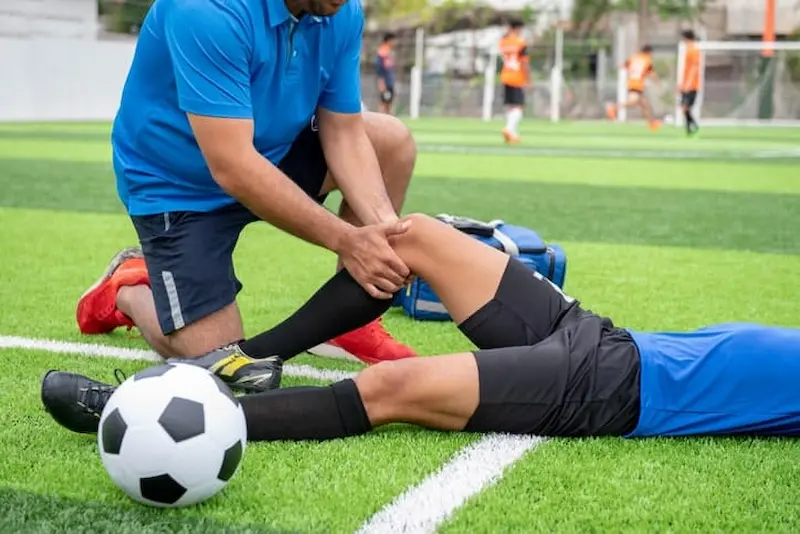
One of the world’s most common injuries in football. Players are always running, turning, leaping, fighting, and competing for the ball. Although these moves add excitement to the game, they also put a lot of strain on the ligaments, muscles, and joints.
From professional leagues in England and the United States to local football competitions, injuries remain a major challenge for players. Even a relatively small muscle problem can affect performance, reduce playing time, and interrupt an important season.
Which football injuries are the most common, and why do they occur so often?
Three injuries deserve particular attention: hamstring strains, ankle sprains, and groin injuries. These problems frequently affect footballers because of the repeated sprinting, sudden movements, and physical demands involved in the game.
Research involving Major League Soccer players between 2014 and 2019 identified hamstring strains, ankle sprains, and adductor strains as the three most frequently reported injury types.
Understanding these injuries can help players recognize warning signs, make better training decisions, and reduce avoidable injury risks.
Let’s examine each injury, its causes, symptoms, treatment approaches, and prevention strategies.
READ MORE: https://sportstitanofficial.com/who-made-the-fastest-century-in-ipl/
https://x.com/Utd__max10/status/2089732527636230171?a=_DCqPAWZJKV5XYIo2w8&s=20
1. Hamstring Strains
One of the most common muscle conditions in football is hamstring strains. They affect the muscles located at the back of the thigh, which play an important role in running, sprinting, and controlling leg movements.
Footballers depend heavily on their hamstrings during acceleration and high-speed running. These muscles also help slow down the lower leg when a player extends the knee.
When the muscles are stretched beyond their capacity or exposed to excessive force, small muscle fibers can become damaged.
Why Do Hamstring Injuries Happen in Football?
Football involves repeated bursts of acceleration and sudden changes in speed. During a sprint, the hamstrings work extremely hard, particularly when the leg moves forward and prepares to make contact with the ground.
Several factors can increase the risk:
- Sudden acceleration during a match.
- Inadequate warm-up before intense activity.
- Muscle fatigue during the second half.
- Previous hamstring injuries.
- Insufficient strength and conditioning.
- Sudden increases in training intensity.
Players who repeatedly perform high-speed sprints without enough recovery may also experience increased muscle stress.
Common Symptoms of Hamstring Strains
The symptoms depend on how severely the muscle is affected.
Common warning signs include:
- Sudden pain at the back of the thigh.
- Tightness or discomfort while running.
- Difficulty accelerating or sprinting.
- Swelling or bruising in more serious cases.
- Pain when bending the knee or stretching the leg.
- Reduced strength in the affected muscle.
A mild strain may cause discomfort without completely stopping a player from walking. A severe injury can make normal movement difficult.
How Are Hamstring Injuries Treated?
Treatment depends on the severity of the injury. Medical professionals generally assess the affected muscle before recommending a rehabilitation program.
Early management may involve protecting the injured area, temporarily reducing painful activity, and controlling swelling.
Once the initial symptoms improve, rehabilitation usually focuses on gradually restoring:
- Normal movement and flexibility.
- Hamstring strength.
- Hip and leg stability.
- Running and acceleration ability.
- High-speed sprinting capacity.
Returning to football too early can increase the risk of another injury. Players should regain the required strength and running ability before returning to competitive matches.
How Can Footballers Prevent Hamstring Strains?
A structured warm-up, progressive sprint training, and appropriate strength exercises can help reduce injury risk.
Exercises such as Nordic hamstring curls are commonly used in football conditioning programs to improve hamstring strength.
Players should also increase sprinting intensity gradually instead of moving directly from low-intensity training to maximum-speed running.
2. Ankle Sprains
Ankle sprains are another frequent problem in football. They occur when the ligaments supporting the ankle are stretched or torn.
Ligaments are strong bands of tissue that connect bones and help stabilize joints. During football matches, players frequently place their ankles under pressure through sudden turns, tackles, jumps, and awkward landings.
An ankle sprain can affect players at every level, from beginners to experienced professionals.
Why Do Ankle Sprains Happen?
Football requires players to change direction quickly while maintaining balance and control.
Sometimes, the foot lands in an awkward position or rolls inward, placing excessive stress on the ligaments outside the ankle.
Common causes include:
- Landing incorrectly after a jump.
- Turning suddenly while running.
- Stepping on another player’s foot.
- Direct contact during tackles.
- Playing on uneven surfaces.
- Returning before a previous ankle injury has healed properly.
Previous ankle sprains are particularly important because they can leave the joint less stable if rehabilitation is incomplete.
Common Symptoms of Ankle Sprains
The symptoms can range from mild discomfort to significant joint instability.
Players may experience:
- Pain around the ankle.
- Swelling after an injury.
- Bruising around the affected area.
- Difficulty putting weight on the foot.
- Reduced ankle movement.
- A feeling that the ankle may give way.
A severe sprain may involve significant ligament damage and require a longer rehabilitation period.
How Are Ankle Sprains Treated?
The treatment approach depends on the severity of the injury and the ligaments involved.
A healthcare professional may recommend temporary activity modification, appropriate pain management, and rehabilitation exercises.
Recovery commonly involves:
1. Managing pain and swelling: The initial priority is protecting the injured ankle and reducing discomfort.
2. Restoring movement: Controlled ankle movements help gradually restore normal joint mobility.
3. Improving strength: Exercises targeting the ankle and surrounding muscles help rebuild stability.
4. Balance training: Single-leg balance and controlled movement exercises help improve coordination.
5. Returning to football: Players gradually progress towards jogging, sprinting, jumping, and changing direction.
Players should not return to competitive football simply because the swelling has disappeared. They also need sufficient strength, balance, and confidence in the injured ankle.
How Can Footballers Prevent Ankle Sprains?
Ankle stability and balance are important parts of football conditioning.
Players can reduce their risk by incorporating balance exercises, strengthening the muscles around the ankle, and practicing controlled changes of direction.
Appropriate footwear and proper rehabilitation after previous ankle injuries are also important.
3. Groin Injuries (Adductor Strains)
Groin injuries are another common problem among footballers, particularly those who frequently sprint, kick, and change direction.
The adductor muscles are located along the inner thigh. Their primary role is to bring the legs towards the body’s center and help control hip movement.
These muscles work continuously during football. Players use them when passing, shooting, accelerating, and maintaining balance.
When the muscles are exposed to excessive force, they may become overstretched or develop small tears.
Why Do Groin Injuries Happen?
Football requires repeated movements that place considerable stress on the inner thigh muscles.
A player may experience a groin strain while attempting a powerful shot, stretching for the ball or suddenly changing direction.
Some common causes include:
- Powerful kicking movements.
- Sudden sideways movements.
- Rapid acceleration and deceleration.
- Inadequate muscle strength.
- Poor hip mobility.
- Training overload.
- Insufficient recovery between sessions.
Groin problems may also develop gradually because of repeated stress rather than one specific incident.
Common Symptoms of Groin Injuries
The symptoms usually affect the inner thigh or the area where the thigh meets the pelvis.
Players may notice:
- Pain in the inner thigh.
- Discomfort while kicking the ball.
- Pain during sprinting.
- Tightness when changing direction.
- Tenderness around the groin.
- Reduced strength when bringing the legs together.
Some players initially ignore mild groin discomfort and continue training. However, repeatedly placing stress on an injured muscle can make the problem worse.
How Are Groin Injuries Treated?
Groin injury treatment depends on the affected muscles and the severity of the damage.
A sports medicine professional may assess muscle strength, hip movement, and pain before developing a rehabilitation plan.
Recovery generally focuses on:
- Reducing painful activities.
- Restoring normal hip movement.
- Gradually strengthening the adductor muscles.
- Improving core and hip stability.
- Reintroducing running and kicking.
- Progressing towards full football training.
Players should avoid returning to powerful kicking and high-speed movements until they can perform these activities without significant pain or functional limitations.
How Can Footballers Prevent Groin Injuries?
Building stronger hip and adductor muscles can help footballers prepare for the physical demands of the game.
Exercises such as Copenhagen adduction, when introduced at an appropriate level, are commonly used in football strength programs.
Players should also develop balanced lower-body strength and avoid sudden increases in training volume.
Comparison of the Top 3 Football Injuries
Understanding how these injuries differ can help players recognize the affected body areas and the movements that commonly cause problems.
| Injury | Affected Area | Common Cause |
|---|---|---|
| Hamstring strain | Back of the thigh | Sprinting and acceleration |
| Ankle sprain | Ankle ligaments | Awkward landing and sudden turning |
| Groin strain | Inner thigh | Kicking and sideways movements |
Although these injuries affect different parts of the body, they share several risk factors, including fatigue, previous injuries and insufficient preparation for intense physical activity.
Which Football Injuries Keep Players Out for the Longest Time?
Not all football injuries have the same consequences.
Some injuries may cause only a short interruption to training, while others can keep players away from competitive football for several months.
The recovery period depends on the severity of the injury, the affected tissues, the player’s physical condition and the quality of rehabilitation.
Here are some examples of injuries that can result in significant time away from football.
1. ACL Injuries
The anterior cruciate ligament (ACL) is an important ligament inside the knee. It helps stabilize the joint, particularly during sudden stops, turns and changes of direction.
An ACL tear can occur when a player changes direction suddenly, lands awkwardly or experiences a collision.
This injury is particularly serious because it may require surgery followed by extensive rehabilitation.
Returning to competitive football often takes many months, and recovery decisions should be based on medical assessment and functional testing rather than a fixed calendar.
2. Achilles Tendon Injuries
The Achilles tendon connects the calf muscles to the heel bone. It plays an essential role in running, jumping and pushing the body forward.
A complete rupture can cause sudden pain and significant difficulty walking or pushing off the affected foot.
Depending on the injury, treatment may involve surgery or non-surgical rehabilitation.
3. Meniscus Injuries
The meniscus is a type of cartilage inside the knee that helps distribute weight and absorb pressure.
Footballers may damage the meniscus while twisting their knees under load or during contact situations.
Symptoms can include pain, swelling, stiffness and difficulty moving the knee.
Some meniscus injuries respond to non-surgical treatment, while others may require an operation.
How Common Are Football Injuries?
Football injury research provides useful information about the physical demands of the sport.
A six-year prospective study of Major League Soccer players covering 2014–2019 found that:
- Hamstring strains accounted for 12.3% of reported injuries.
- Ankle sprains accounted for 8.5%.
- Adductor strains accounted for 7.6%.
- Match injury incidence was approximately 4.1 times higher than training injury incidence.
The findings highlight how frequently the lower body is affected during competitive football.
A separate systematic review of professional football research found that muscle and tendon injuries represented the largest injury category.
However, injury rankings can differ depending on the competition, player population, injury definitions and research methods. Professional players may also experience different injury patterns from recreational footballers.
This is why the most common injuries in football should be understood as a group of recurring problems rather than a universal ranking that applies equally to every player.
7 Effective Ways to Prevent Football Injuries
Preventing every injury is impossible, but players can take practical steps to reduce avoidable risks.
Here are seven useful strategies for footballers.
1. Always Complete a Proper Warm-Up
A warm-up prepares the body for physical activity by gradually increasing movement intensity.
Players should include light running, dynamic movements, controlled acceleration and football-specific exercises before intense training or matches.
2. Build Lower-Body Strength
Strong muscles help players manage the physical demands of sprinting, jumping and changing direction.
Strength exercises should target the hamstrings, quadriceps, calves, glutes and adductor muscles.
3. Improve Balance and Coordination
Footballers frequently perform movements that challenge their stability.
Single-leg balance exercises, controlled landings and movement drills can help improve coordination.
4. Avoid Sudden Training Increases
Increasing training intensity too quickly can expose muscles and joints to loads they are not prepared to handle.
Players should gradually build sprinting distance, training duration and match intensity.
5. Give Your Body Enough Recovery Time
Recovery is an important part of football conditioning.
Adequate sleep, nutrition, hydration and appropriate rest between demanding sessions support physical performance.
6. Never Ignore Persistent Pain
Minor discomfort can sometimes develop into a more serious problem when players continue training without proper assessment.
Persistent pain, swelling or reduced movement should be evaluated by a qualified healthcare professional.
7. Follow a Structured Injury Prevention Programme
The FIFA 11+ programme is a well-known football warm-up and injury prevention programme that includes running, strength, balance and movement-control exercises.
Research reviews have found that structured football injury prevention programmes can reduce injury risk when implemented consistently.
When Should a Footballer See a Doctor?
Players should not assume that every injury is simply a muscle pull or minor sprain.
Professional medical assessment is important when symptoms are severe, persistent or getting worse.
Seek prompt medical attention if you experience:
- Severe pain after a football injury.
- Significant swelling or bruising.
- Inability to put weight on the injured leg.
- A joint that looks deformed or unstable.
- A sudden popping sensation followed by major pain or loss of function.
- Numbness or unusual changes in sensation.
Suspected fractures, serious ligament injuries and complete tendon ruptures require appropriate medical evaluation.
A proper diagnosis helps determine the safest treatment and rehabilitation approach.
Frequently Asked Questions (FAQs)
1. What are the top 3 most common injuries in football?
The three frequently reported football injuries are hamstring strains, ankle sprains and groin or adductor strains. Their frequency can vary depending on the competition and player population.
2. What is the most common muscle injury in football?
Hamstring strains are among the most frequently reported muscle injuries in football. They commonly occur during sprinting, acceleration and high-speed running.
3. Why do football players get so many injuries?
Football involves repeated sprinting, tackling, jumping and sudden changes of direction. These movements place considerable stress on muscles, ligaments and joints, increasing the risk of injury.
4. Which football injury takes the longest to recover from?
Serious ACL tears and complete Achilles tendon ruptures can require many months of rehabilitation. Recovery depends on injury severity, treatment and individual progress.
5. Are ankle injuries common in professional football?
Yes. Ankle sprains are frequently reported in professional football. They often happen during awkward landings, tackles and sudden changes of direction.
6. How can footballers avoid hamstring injuries?
Players can reduce their risk through structured warm-ups, progressive sprint training, appropriate recovery and strengthening exercises such as Nordic hamstring curls.
7. Can footballers play with a minor injury?
It depends on the injury and its severity. Playing through pain can sometimes worsen an existing problem. Players should seek appropriate medical advice before continuing competitive activity.
Conclusion
Football demands speed, strength, balance and constant movement. These qualities make the game exciting, but they also expose players to different types of physical injuries.
Hamstring strains, ankle sprains and groin injuries are among the most frequently reported problems in football. Each can affect a player’s movement, performance and ability to compete.
The good news is that proper preparation, strength training, recovery and injury prevention programmes can help reduce many avoidable risks.
Whether someone plays in the Premier League, Major League Soccer or a local football competition, understanding injury patterns is an important part of becoming a better and more prepared player.
Ultimately, staying fit is not just about training harder. It is also about understanding the body’s limits, recognizing warning signs and giving it enough time to recover.










1 thought on “What Are the Top 3 Most Common Injuries in Football?”