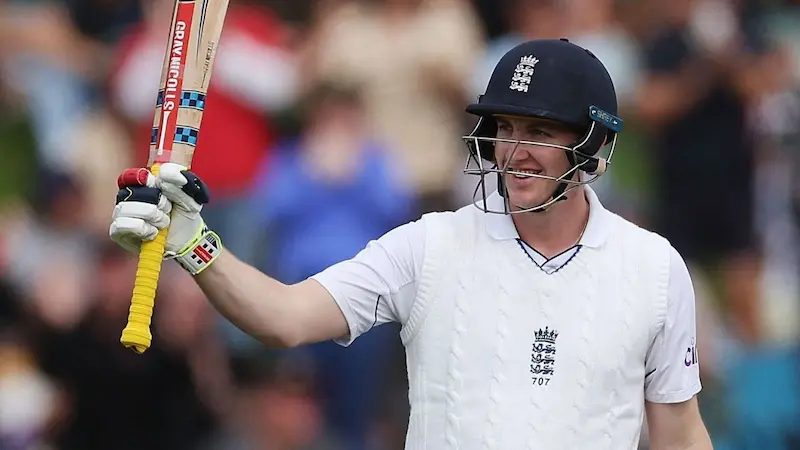
Scoring a century in Test cricket is always special. However, reaching 100 runs in fewer than 75 balls requires impeccable timing, self-confidence, and an aggressive edge. It can completely shift the momentum of a match, put the opposition under pressure, and create a moment that cricket fans will remember for generations.
The fastest centuries in test cricket history include remarkable performances from Brendon McCullum, Viv Richards, Misbah-ul-Haq, Adam Gilchrist, and several other legendary batters. Their innings prove that Test cricket can produce the same excitement and explosive scoring associated with limited-overs formats.
Brendon McCullum currently holds the men’s world record with a century in just 54 balls. Travis Head’s 69-ball hundred in the 2025 Ashes also brought fresh attention to this extraordinary record list.
Let’s look at the top ten ranking positions, the players behind these achievements, and the match situations that made their centuries so memorable.
How Is the Fastest Test Century Record Ca
READ MORE: https://sportstitanofficial.com/india-batters-vs-new-zealand-pace-attack/
https://x.com/cricbuzz/status/2118400340676771962?a=m1LUOo_ueiGOPgB_Vz0&s=20
How Is the Fastest Test Century Record Calculated?
The record is based on the number of legal deliveries a batter faces before reaching 100 runs. It is not calculated by the total time spent at the crease.
For example, a batter who reaches a century after facing 54 balls ranks ahead of someone who takes 56 balls. The deliveries faced after reaching 100 do not affect the record.
It is also important to understand that a century scored in 60 minutes is a different record from one scored in 60 balls. Both measurements describe speed, but they use different methods.
The following table covers the top ten ranking positions in men’s Test cricket, including players who share the same record.
Top 10 Fastest Centuries in Test Cricket History
| Rank | Player | Country | Balls to 100 | Opponent | Year |
|---|---|---|---|---|---|
| 1 | Brendon McCullum | New Zealand | 54 | Australia | 2016 |
| 2 | Viv Richards | West Indies | 56 | England | 1986 |
| 2 | Misbah-ul-Haq | Pakistan | 56 | Australia | 2014 |
| 4 | Adam Gilchrist | Australia | 57 | England | 2006 |
| 5 | Jack Gregory | Australia | 67 | South Africa | 1921 |
| 6 | Shivnarine Chanderpaul | West Indies | 69 | Australia | 2003 |
| 6 | David Warner | Australia | 69 | India | 2012 |
| 6 | Travis Head | Australia | 69 | England | 2025 |
| 9 | Chris Gayle | West Indies | 70 | Australia | 2009 |
| 10 | Roy Fredericks | West Indies | 71 | Australia | 1975 |
| 10 | Colin de Grandhomme | New Zealand | 71 | West Indies | 2017 |
There are 11 players across these ten positions because three batters share sixth place and two share tenth place.
1. Brendon McCullum – 54 Balls vs Australia (2016)
Brendon McCullum owns one of the most extraordinary records in international cricket. He reached his Test century in only 54 deliveries against Australia in Christchurch on February 20, 2016.
The timing made the achievement even more special. It was McCullum’s final Test match, and he wanted to finish his international career with a memorable performance.
New Zealand had lost early wickets and were struggling at 32 for 3. Australia appeared to have control of the game, but McCullum had other plans.
He attacked from the beginning, using his quick footwork and powerful stroke play to put the Australian bowlers under pressure. He found gaps, cleared the boundary, and refused to allow the opposition to settle into a comfortable rhythm.
McCullum eventually scored 145 runs from 79 balls, including 21 fours and six sixes. His century came from just 54 deliveries, breaking the previous record shared by Viv Richards and Misbah-ul-Haq.
His innings helped New Zealand recover from a difficult position and reach 370 in their first innings. Although Australia won the Test, McCullum’s performance became the defining moment of the match.
It was a fitting farewell for a captain who had built his reputation on positive cricket and fearless leadership.
2. Viv Richards – 56 Balls vs England (1986)
Sir Vivian Richards was one of the most dominant batters of his generation. His confidence, timing, and ability to attack fast bowling made him a difficult opponent for any team.
In April 1986, Richards produced an outstanding innings against England in Antigua. He reached his century in only 56 balls, setting a new benchmark for the quickest Test hundred at that time.
Richards did not rely on cautious batting. He played with authority, punished loose deliveries, and regularly found the boundary. His unbeaten 110 came from just 58 deliveries.
The West Indies side was already in a strong position, but Richards made the advantage even greater. His attacking approach left England’s bowlers with very few opportunities to control the scoring rate.
West Indies won the match by 240 runs and completed a 5-0 series victory.
Richards held the fastest-century record for nearly three decades. Misbah-ul-Haq matched his achievement in 2014, before McCullum moved ahead with his remarkable 54-ball hundred.
His innings remains one of the finest examples of fearless batting in Test cricket.
2. Misbah-ul-Haq – 56 Balls vs Australia (2014)
Misbah-ul-Haq was known for his calm personality and disciplined approach. He often preferred to build an innings carefully, making his incredible performance against Australia even more surprising.
During the second Test in Abu Dhabi in November 2014, Misbah matched Viv Richards’ record by reaching 100 in just 56 balls.
Interestingly, his two innings in the same match showed completely different approaches. In Pakistan’s first innings, he scored a patient century from 168 deliveries. In the second innings, he attacked the Australian bowlers and reached another hundred in only 56 balls.
He finished unbeaten on 101 from 57 deliveries, striking 11 fours and five sixes.
Pakistan had already established a strong position in the match and eventually set Australia a massive target of 603 runs. Australia was dismissed for 246, giving Pakistan a convincing 356-run victory.
Misbah’s performance demonstrated how an experienced batter can adjust his approach according to the match situation. He could defend for hours when necessary, but he was equally capable of attacking when the opportunity appeared.
His 56-ball century remains one of Pakistan’s most memorable Test batting performances.
4. Adam Gilchrist – 57 Balls vs England (2006)
Adam Gilchrist changed the way people viewed wicketkeeper-batters. Before his arrival, wicketkeepers were often selected primarily for their work behind the stumps. Gilchrist proved that a wicketkeeper could also become one of the most destructive batters in the team.
His outstanding century against England came during the 2006–07 Ashes series in Perth.
Gilchrist had been dismissed for a duck in Australia’s first innings. In the second innings, he responded with a remarkable attacking performance, reaching his century in only 57 balls.
He finished unbeaten on 102 from 59 deliveries, hitting 12 fours and four sixes.
England’s bowling attack struggled to contain him. Gilchrist attacked with confidence and made scoring look surprisingly simple, even against an experienced opposition.
Australia won the Test by 206 runs and took control of the Ashes series.
His innings remains an important part of his legacy. Gilchrist was not just a talented wicketkeeper; he was a match-winning batter who could change the direction of a Test in a single session.
5. Jack Gregory – 67 Balls vs South Africa (1921)
Jack Gregory’s achievement is particularly impressive because it happened more than a century ago.
The Australian all-rounder reached his century in just 67 balls against South Africa in Johannesburg during the 1921–22 series.
Gregory played in a very different era. Modern protective equipment, advanced batting technology, and today’s training methods were not available. Yet he produced a scoring rate that would be remarkable even in contemporary cricket.
He eventually scored 119 runs, striking 19 fours and two sixes.
Gregory’s achievement is also associated with another major record. His century took approximately 70 minutes, making it the fastest Test hundred by time taken according to the historical record.
His performance helped establish him as one of Australia’s most exciting players of that period. It also demonstrated that aggressive batting was not invented by modern cricket.
Gregory’s record for the fastest hundred by balls faced was eventually broken by Viv Richards in 1986.
6. Shivnarine Chanderpaul – 69 Balls vs Australia (2003)
Shivnarine Chanderpaul was one of the most dependable batters in West Indies cricket. His unusual stance, strong concentration, and ability to survive difficult conditions made him an important part of the team.
However, his performance against Australia in Georgetown in April 2003 revealed another side of his batting.
Chanderpaul reached his century in just 69 balls, attacking an Australian bowling attack that was among the strongest in international cricket.
His innings included 15 fours and two sixes. He combined patience with powerful stroke play, taking advantage of scoring opportunities without losing his composure.
One of the most important aspects of his performance was the situation in which he batted. West Indies needed a strong response, and Chanderpaul helped the team recover by building an important partnership with Ridley Jacobs.
His performance demonstrated that an experienced test batter could change gears without abandoning the technique that made him successful.
Chanderpaul’s 69-ball hundred remains one of the most memorable innings of his career.
6. David Warner – 69 Balls vs India (2012)
David Warner became one of the most aggressive opening batters in modern Test cricket. His ability to attack bowlers from the first over often gave Australia a strong start.
He demonstrated that ability against India at the WACA Ground in Perth in January 2012.
India had been dismissed for 161 in their first innings. Warner came out to open Australia’s reply and immediately put the Indian bowlers under pressure.
He reached his century in only 69 balls and remained unbeaten on 104 at the end of the first day. Warner continued his aggressive approach the following day before eventually scoring 180 runs.
His innings helped Australia take a commanding position in the match. The hosts eventually won by an innings and 37 runs.
Warner’s performance was a reminder that an attacking opening batter can change the mood of a Test match very quickly. Instead of allowing India to build pressure with the ball, he forced the bowlers to defend.
His 69-ball hundred remains one of the quickest centuries ever scored by an Australian opener.
6. Travis Head – 69 Balls vs England (2025)
Travis Head produced one of the most exciting batting performances of the 2025–26 Ashes series during the first Test against England in Perth.
Australia needed 205 runs to win the match. With Usman Khawaja unavailable to open because of a back problem, Head moved to the top of the batting order.
He responded with an extraordinary attacking innings.
Head reached his century in only 69 balls, joining Chanderpaul and Warner at that position on the all-time list. He eventually scored 123 runs from 83 deliveries, hitting 16 fours and four sixes.
Australia chased the target in just 28.2 overs and won the match by eight wickets.
The performance was particularly impressive because of the pressure associated with an Ashes contest. England needed early wickets to defend their target, but Head’s aggressive approach quickly changed the situation.
His innings also demonstrated how modern players are increasingly comfortable attacking in the fourth innings of a Test match.
Head’s 69-ball hundred is among the most memorable recent additions to the record list.
9. Chris Gayle – 70 Balls vs Australia (2009)
Chris Gayle was famous for his powerful hitting and ability to dominate bowling attacks. Although many fans remember him primarily for his performances in T20 cricket, he was also a dangerous Test batter.
His century against Australia in Perth in December 2009 demonstrated his attacking ability in the longest format.
Australia had declared their first innings at 520 for 7. West Indies needed a strong response, and Gayle gave them an aggressive start.
He reached his century in just 70 balls and finished with 102 runs from 72 deliveries. His innings included nine fours and six sixes.
Gayle attacked the Australian bowlers with confidence, using his strength to clear the boundary and find gaps in the field.
Although he was dismissed shortly after reaching his hundred, his innings had already made a major impact.
The performance showed that Gayle’s explosive batting was not limited to shorter formats. He could also produce remarkable scoring rates against a quality Test bowling attack.
10. Roy Fredericks – 71 Balls vs Australia (1975)
Roy Fredericks was one of the most entertaining opening batters of his generation. He was known for attacking bowlers and playing with confidence, even against strong opposition.
His remarkable innings came against Australia in Perth during the 1975–76 series.
Fredericks reached his century in just 71 balls, producing an innings that was far ahead of its time. He eventually scored 169 runs from 145 deliveries.
His performance was especially impressive because of the quality of the Australian attack and the era in which he played.
Fredericks did not wait for bowlers to make repeated mistakes. He looked for scoring opportunities and used his attacking instincts to put Australia under pressure.
His innings became one of the most memorable performances of the series and helped establish his reputation as an aggressive opening batter.
Even decades later, his 71-ball hundred remains among the quickest in Test cricket.
10. Colin de Grandhomme – 71 Balls vs West Indies (2017)
Colin de Grandhomme was a powerful New Zealand all-rounder who could contribute with both bat and ball. His ability to score quickly made him particularly valuable in the middle and lower order.
He produced one of his finest Test performances against West Indies in Wellington in December 2017.
De Grandhomme reached his century in just 71 balls, showing excellent timing and impressive power. He eventually scored 105 runs, helping New Zealand strengthen their position.
His innings was an important contribution in a match where New Zealand controlled much of the contest. The home side eventually won by 240 runs.
De Grandhomme’s performance highlighted the value of having aggressive all-rounders in Test cricket. A lower-order batter who can score quickly can add crucial runs and change the balance of a match.
His 71-ball century places him alongside Roy Fredericks in the tenth position on this list.
What Makes These Test Centuries So Special?
Scoring a Test hundred requires concentration and technical ability. Doing it in fewer than 75 balls demands something extra.
The players on this list combined natural attacking instincts with an understanding of match conditions. Their performances were not simply the result of careless hitting.
Outstanding Shot Selection
Fast scoring does not mean attacking every delivery. The best batters recognise which balls they can score from and which ones deserve respect.
McCullum, Richards and Gilchrist were particularly effective at identifying scoring opportunities. They attacked with confidence but also understood how to manage risk.
Confidence Under Pressure
A batter attempting to score quickly must remain mentally strong. One missed shot or a close call can affect confidence, especially when the bowling side is looking for a breakthrough.
The players on this list maintained their attacking intent even when the match situation was challenging.
Ability to Read the Bowling Attack
Every bowling attack has different strengths. Some rely on pace and bounce, while others use swing, seam movement or spin.
Successful attacking batters understand how to respond to these differences. They adjust their footwork, shot selection and scoring areas according to the bowler.
Understanding the Match Situation
A fast century can serve different purposes.
Sometimes a team needs quick runs after losing early wickets. In other situations, a batter can accelerate when the team is already in a strong position.
The best innings combine an understanding of the match with the ability to score quickly without taking unnecessary risks.
Who Has the Fastest Test Century for India?
India has also produced several outstanding attacking Test batters. The country’s fastest Test century by balls faced is jointly held by Kapil Dev and Mohammad Azharuddin, who both reached 100 in 74 deliveries.
Kapil Dev achieved the record against Sri Lanka in Kanpur in December 1986. Mohammad Azharuddin matched it against South Africa in Kolkata in December 1996.
Other notable Indian performances include:
- Virender Sehwag – 78 balls against West Indies in 2006.
- Virender Sehwag – 82 balls against New Zealand in 2009.
- Shikhar Dhawan – 85 balls against Australia in 2013.
- Hardik Pandya – 86 balls against Sri Lanka in 2017.
These innings show that Indian batters have also played an important role in the development of aggressive Test batting.
Has Modern Test Cricket Become More Aggressive?
Modern Test cricket has certainly become more attacking. Players are increasingly willing to take risks, use innovative shots and put pressure on bowlers from the beginning of an innings.
The influence of T20 and one-day cricket has helped players develop a wider range of attacking options. However, aggressive Test batting existed long before those formats became popular.
Viv Richards and Roy Fredericks were attacking players during an earlier era. McCullum later became one of the most influential figures in modern aggressive Test cricket, while Travis Head has continued that approach.
England’s Bazball philosophy has also brought attention to positive batting. The approach encourages players to put pressure on the opposition rather than simply waiting for scoring opportunities.
However, scoring quickly does not automatically guarantee success. Test matches still require partnerships, sound judgement and the ability to adapt to changing conditions.
The best attacking batters understand when to accelerate and when to defend.
Frequently Asked Questions
Who holds the record for the fastest century in Test cricket?
Brendon McCullum holds the men’s Test record. He scored a century in just 54 balls against Australia at Hagley Oval in Christchurch on February 20, 2016.
Who scored the second-fastest Test century?
Viv Richards and Misbah-ul-Haq share the second position. Both players reached their centuries in 56 balls.
How many balls did Adam Gilchrist take to score his Test century?
Adam Gilchrist reached his hundred in 57 balls against England at Perth during the 2006–07 Ashes series.
Who scored the fastest Test century for India?
Kapil Dev and Mohammad Azharuddin jointly hold India’s fastest Test century record. Both reached 100 in 74 balls.
Did Travis Head score a 69-ball Test century?
Yes. Travis Head reached his hundred in 69 balls against England during the first Test of the 2025–26 Ashes series in Perth. He finished with 123 runs from 83 deliveries.
Is the fastest Test century measured in balls or minutes?
The standard record is measured by balls faced. A separate record tracks the fastest Test hundred by time taken in minutes.
Can a Test century be faster than an ODI century?
Yes. Test cricket has no minimum time requirement for scoring runs. A batter can attack from the beginning and reach 100 in fewer balls than an ODI batter.
Conclusion
The fastest centuries in test cricket history show why the longest format remains one of the most exciting forms of cricket. Although patience and technique are essential, these extraordinary innings prove that attacking cricket can also produce unforgettable moments in Test matches.
Brendon McCullum remains at the top with his remarkable 54-ball century. Viv Richards and Misbah-ul-Haq follow with 56-ball hundreds, while Adam Gilchrist and Jack Gregory also occupy special places in the record books.
The achievements of Chanderpaul, Warner, Head, Gayle, Fredericks and de Grandhomme show that explosive batting has been part of Test cricket across different generations.
Records are made to be challenged, and modern players continue to push the limits of what is possible. Whether anyone can break McCullum’s 54-ball record remains an exciting question for cricket fans.









1 thought on “Top 10 Fastest Centuries in Test Cricket History: Records That Changed the Game”